
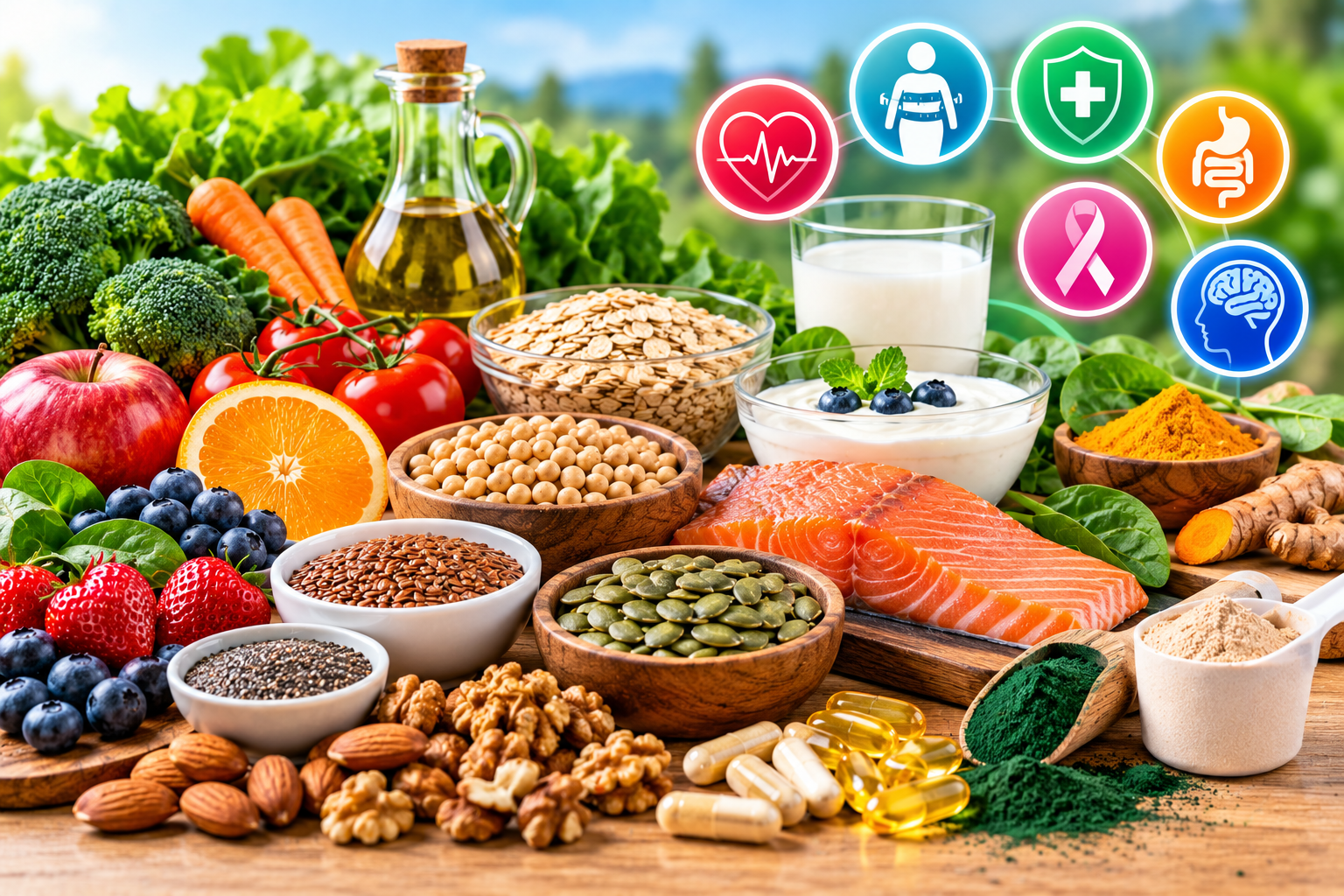
1. Introduction: Why Are Functional Foods Important?
Nutrition plays an essential role in human growth, development, and long-term health. Beyond providing energy and essential nutrients, some foods contain biologically active compounds that researchers have investigated for their potential health effects.
These foods and food-derived products have become increasingly important in nutrition research, food technology, and the development of health-oriented products.
In their review, Nutraceuticals and Functional Foods: The Foods for the Future World, Gul and colleagues (2016) discuss how foods containing bioactive compounds may contribute to health promotion and potentially reduce the risk of certain chronic diseases.
The review highlights cardiovascular diseases, obesity, and cancer as important areas of investigation. It also emphasizes that more research is needed to substantiate many proposed health benefits and establish a strong scientific basis for health claims.
2. What Are Functional Foods?
Functional foods are conventional foods that provide benefits beyond their basic nutritional value when consumed as part of a normal diet. These benefits must be supported by appropriate scientific evidence.
Functional foods may naturally contain beneficial compounds or be modified during food processing to increase their content of selected nutrients or bioactive ingredients.
Examples include
- Broccoli: Contains glucosinolates, including compounds associated with the formation of sulforaphane.
- Carrots: Provide beta-carotene, which the body can convert into vitamin A.
- Tomatoes: Contain lycopene, a carotenoid that has attracted scientific interest.
- Oats: Provide beta-glucan, a soluble dietary fiber studied for its effects on blood cholesterol.
- Yogurt containing suitable probiotic cultures: Provides live microorganisms that have been studied for their effects on digestive health.
Functional foods may also include products fortified with calcium, vitamin D, omega-3 fatty acids, or other nutrients.
The central idea is that these foods can provide nutritional value while offering additional benefits supported by evidence relevant to the specific food and its composition.
3. What Are Nutraceuticals?
The term "nutraceutical" combines the concepts of nutrition and pharmaceuticals. It generally refers to food-derived substances or products marketed in concentrated forms for health-related purposes.
As described in the review, nutraceuticals may be available as capsules, tablets, powders, extracts, or liquids rather than as conventional foods.
Examples include concentrated food-derived compounds, certain antioxidant preparations, probiotics, vitamins, and bioactive peptides.
Although functional foods and nutraceuticals are related, they are not identical.
Functional foods are generally consumed as part of an ordinary diet, such as oats, vegetables, and fortified milk.
Nutraceuticals are generally concentrated or specially formulated products derived from foods and consumed in forms such as capsules, tablets, or powders.
The distinction is important for consumers and food businesses because a product's nutritional composition, intended use, quality, and applicable regulatory requirements determine how it should be marketed.
Not every product described as a nutraceutical has proven clinical benefits, and the term itself does not guarantee effectiveness or safety.
4. Functional Foods and Cardiovascular Health
Cardiovascular diseases include conditions affecting the heart and blood vessels, such as coronary heart disease and stroke.
The review explains that dietary patterns rich in fruits, vegetables, whole grains, and dietary fiber have been associated with better cardiovascular health.
Several food components have attracted particular research interest.
Oats and beta-glucan
Oats contain beta-glucan, a soluble fiber that has been studied for its ability to help lower total and LDL cholesterol. Regularly including suitable oat products in a balanced diet can be one practical way to increase fiber intake.
Soybeans and soy protein
Soybeans provide plant protein, fiber, and isoflavones. The review discusses research investigating soy protein and its possible effects on blood cholesterol levels.
The effects can depend on the food product, the amount consumed, and the dietary pattern in which it is included.
Fish and omega-3 fatty acids
Fish provides high-quality protein and, in many species, omega-3 fatty acids. These fats have been studied extensively for their role in cardiovascular health.
Garlic and other plant foods
Garlic contains sulfur-containing compounds that have been investigated for possible effects on cholesterol, blood pressure, and other cardiovascular risk factors. However, the evidence discussed in the review was not sufficient to recommend garlic as a routine clinical treatment for hypertension.
Overall, the review supports the importance of a varied, nutrient-rich dietary pattern. Individual foods or supplements should not be treated as replacements for prescribed cardiovascular medication or professional medical care.
5. Functional Foods, Obesity, and Weight Management
Obesity is a complex health condition involving excessive body fat that can increase the risk of several chronic diseases.
Gul and colleagues discuss how dietary patterns, food choices, and lifestyle behaviors contribute to weight management.
Foods rich in dietary fiber, including vegetables, fruits, legumes, and whole grains, can help improve meal quality and support feelings of fullness. These foods can also provide substantial nutritional value without necessarily contributing as much energy as many highly processed, energy-dense products.
The review highlights the potential importance of increasing fiber intake and choosing appropriate foods as part of strategies for managing body weight.
However, no single functional food can independently prevent or treat obesity. Weight management involves a combination of dietary habits, physical activity, sleep, behavioral factors, and individual health circumstances.
For practical purposes, consumers should prioritize balanced meals, appropriate portions, and a variety of minimally processed foods.
6. Functional Foods and Cancer Research
Some foods contain phytochemicals and other bioactive compounds that researchers have investigated for their potential effects on biological processes associated with cancer development.
The review discusses compounds such as carotenoids, polyphenols, and glucosinolates found in various plant foods.
Examples include
- Cruciferous vegetables: Broccoli and related vegetables contain glucosinolates.
- Tomatoes: Provide lycopene and other nutrients.
- Garlic: Contains sulfur-containing compounds.
- Tea: Contains polyphenols, including catechins in green tea.
- Soybeans and flaxseed: Contain different bioactive compounds that have been investigated in nutritional research.
Potential mechanisms discussed in the review include antioxidant activity, effects on enzymes involved in the processing of certain compounds, and changes in cellular processes.
Nevertheless, laboratory findings and associations from observational studies do not establish that a specific food or supplement prevents or cures cancer in humans.
The practical recommendation is to consume a variety of vegetables, fruits, whole grains, and other nutritious foods as part of a balanced dietary pattern. Functional foods and nutraceuticals should never replace cancer screening, medical assessment, or evidence-based treatment.
7. Functional Foods from Plant and Animal Sources
Functional ingredients are found in both plant and animal foods.
Plant-based sources
- Rice bran: Contains dietary fiber, tocotrienols, and other compounds investigated for their nutritional and functional properties.
- Oats: Provide beta-glucan and other compounds.
- Soybeans: Supply protein, fiber, and isoflavones.
- Flaxseed: Contains alpha-linolenic acid, an omega-3 fatty acid, and lignans.
- Garlic: Provides sulfur-containing compounds.
- Tea: Contains polyphenols.
- Fruits and vegetables: Supply vitamins, minerals, fiber, and a range of phytochemicals.
Animal-based sources
- Fish: Supplies protein and, depending on the species, omega-3 fatty acids.
- Milk and dairy products: Provide protein, calcium, and other nutrients.
- Fermented dairy products: Some contain probiotic microorganisms that have been studied for their effects on digestive health.
The review emphasizes that health-promoting compounds are not limited to plants. A balanced dietary pattern can include a suitable variety of foods from different sources according to individual nutritional needs and preferences.
8. The Role of Fortified and Enhanced Foods
Food technology allows manufacturers to develop products with modified nutritional compositions.
The review describes several categories of functional foods:
Naturally functional foods: Foods that naturally contain bioactive compounds, such as carrots containing beta-carotene and oats containing beta-glucan.
Foods with added bioactive ingredients: Products to which ingredients are added during processing, such as milk fortified with selected vitamins or minerals.
Enhanced foods: Products in which the levels of naturally occurring components are increased, for example, through breeding or other production approaches.
Fortification can help address specific nutrient needs when it is appropriately designed and implemented. However, the benefit depends on the nutrient, the amount added, the population's needs, and the overall quality of the diet.
Manufacturers must also ensure that nutritional information and product claims are accurate and supported by suitable evidence.
9. Opportunities for the Food and Nutrition Industry
The growing interest in health-oriented foods creates opportunities for food manufacturers, importers, distributors, and nutrition professionals.
For businesses such as IRONFIBER LTD, potential areas of interest include:
- Nutrient-rich food products and plant-based ingredients.
- Fortified foods developed to address appropriate nutritional needs.
- Food supplements with clearly defined compositions and intended uses.
- Consumer education on balanced diets and responsible supplement use.
- Research and development of functional food products.
However, successful product development requires more than identifying an ingredient with potential health benefits. Businesses must evaluate product quality, ingredient safety, nutritional composition, consumer needs, and applicable regulatory requirements.
Health claims should be scientifically substantiated, accurate, and consistent with the regulations of the target market.
The review also stresses that additional research is needed to clarify the health effects of many bioactive substances and to establish sound scientific criteria for evaluating functional food claims.
10. Conclusion: The Future of Nutrition and Wellness
Functional foods and nutraceuticals represent an important area of nutrition science and food innovation. They offer opportunities to improve dietary quality, develop new food products, and investigate the relationship between food components and human health.
The review by Gul, Singh, and Jabeen (2016) highlights research involving cardiovascular health, obesity, cancer, and several plant- and animal-derived food components.
However, the authors emphasize that the field requires further scientific investigation and that health claims must be supported by credible evidence.
For consumers, the most reliable starting point is a varied and balanced diet based on nutritious foods. Supplements and concentrated nutraceutical products should be selected carefully and should not replace healthy eating or necessary medical treatment.
For the food industry, the future of functional foods depends on responsible innovation, quality assurance, transparent labelling, and evidence-based communication.
IRONFIBER LTD promotes informed nutrition choices, responsible supplement use, and the development of quality-focused food and nutrition products.
Scientific Reference
Gul, K., Singh, A. K., & Jabeen, R. (2016). Nutraceuticals and functional foods: The foods for the future world. Critical Reviews in Food Science and Nutrition, 56(16), 2617–2627. [https://doi.org/10.1080/10408398.2014.903384](https://doi.org/10.1080/10408398.2014.903384)
This article is intended for general nutrition education and is based on a scientific review published in 2016. The review discusses a range of potential health benefits, but the strength of evidence varies by food and health outcome. Nutraceuticals and functional foods are not substitutes for medical diagnosis or treatment.