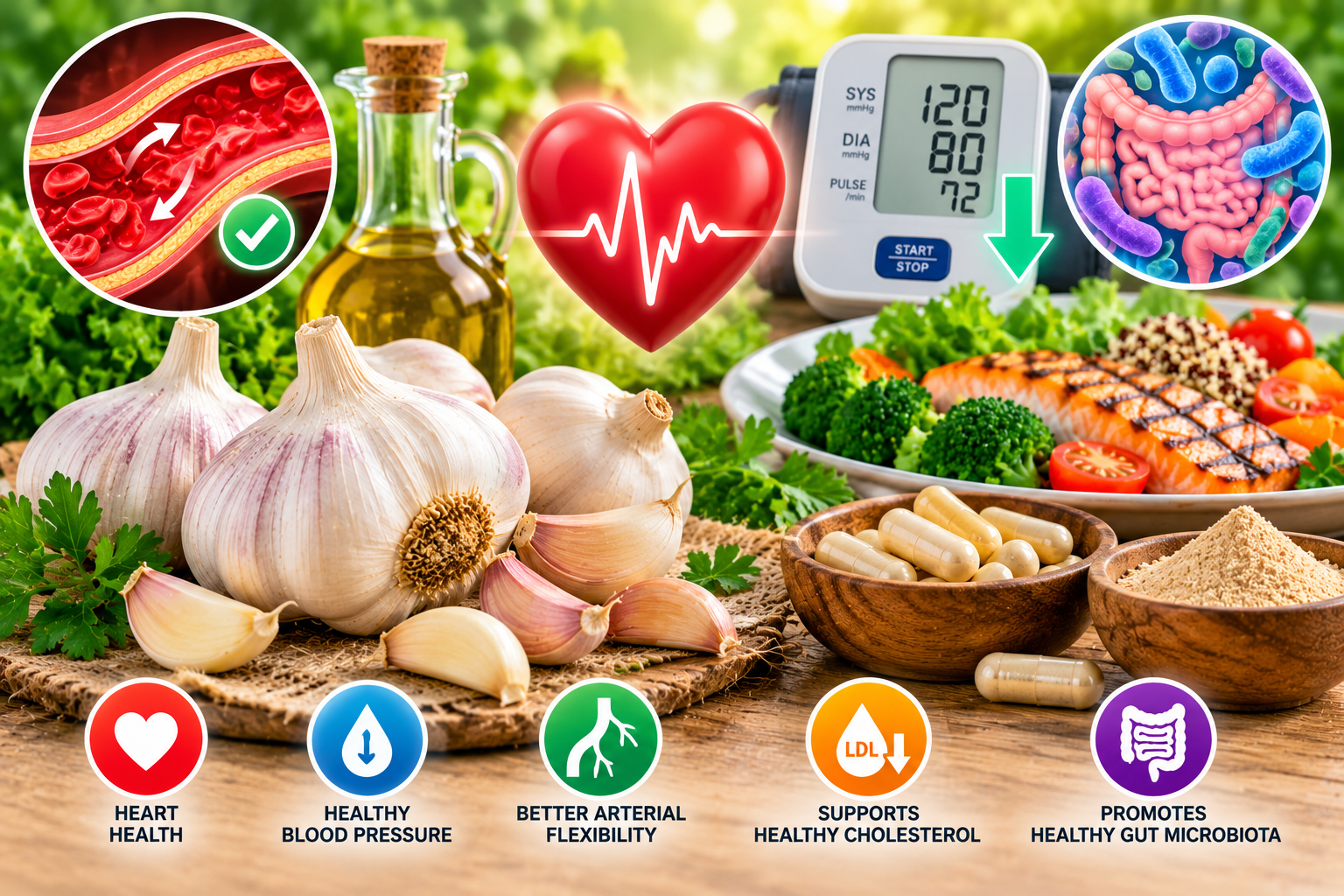
1. Introduction: Why Is Garlic Important for Health?
Garlic (Allium sativum) is a widely used culinary ingredient valued for its distinctive flavor and aroma. Beyond its role in cooking, garlic contains sulfur-containing compounds that have attracted scientific interest because of their potential biological activities.
Researchers have investigated garlic in relation to cardiovascular health, particularly blood pressure, blood cholesterol, blood vessel function, and the gut microbiome.
In the review Garlic Lowers Blood Pressure in Hypertensive Subjects, Improves Arterial Stiffness and Gut Microbiota, published in Experimental and Therapeutic Medicine in 2020, Karin Ried reviewed clinical trials examining garlic supplements and cardiovascular health.
The article included an updated meta-analysis of clinical trials involving adults with hypertension and summarized additional research on aged garlic extract and gut microbiota.
2. Garlic and High Blood Pressure
High blood pressure, also known as hypertension, is a major risk factor for cardiovascular diseases, including heart attack and stroke.
The review analyzed 12 trials involving 553 adults with high blood pressure. The results showed that garlic supplements were associated with average reductions of:
- Systolic blood pressure: Approximately 8.3 mmHg.
- Diastolic blood pressure: Approximately 5.5 mmHg.
These findings were statistically significant in the included trials.
Systolic blood pressure is the pressure in the arteries when the heart contracts, while diastolic blood pressure is the pressure when the heart relaxes between beats.
The review suggested that the reductions observed with garlic supplements could be clinically meaningful. However, the results came from specific supplement preparations studied under clinical conditions and should not be assumed to apply equally to raw garlic, garlic powder, aged garlic extract, or every commercially available supplement.
The findings also do not mean that garlic can replace prescribed antihypertensive medication. People with hypertension should continue their treatment and discuss any supplement use with their healthcare professional.
3. What Is Aged Garlic Extract?
Aged garlic extract is a preparation made by aging garlic under controlled conditions. The review describes the production of Kyolic aged garlic extract, in which garlic is aged in an ethanol-based process for an extended period.
During aging, some compounds found in fresh garlic are transformed into more stable constituents, including S-allyl cysteine (SAC), which is discussed in the scientific literature as one of the preparation's important components.
Aged garlic extract is different from fresh garlic, garlic oil, and ordinary garlic powder. Their chemical compositions and potential effects can differ depending on processing methods and product formulation.
In the studies reviewed by Ried, aged garlic extract was investigated for its effects on blood pressure and other cardiovascular measures.
It is important to note that much of the evidence discussed in the article relates to particular formulations. Consumers should not assume that all garlic products will produce the same results.
4. Garlic and Arterial Stiffness
Arteries carry blood from the heart to the body's tissues. Healthy arteries need to maintain an appropriate level of flexibility as blood moves through them.
Arterial stiffness refers to reduced flexibility of the arterial walls. It is associated with aging and is also relevant to cardiovascular risk.
The review summarized clinical research investigating aged garlic extract and measures of arterial function, including pulse wave velocity.
Pulse wave velocity measures how quickly pressure waves travel through the arteries. Higher values generally indicate greater arterial stiffness.
In one trial discussed in the review, aged garlic extract was associated with a reduction in pulse wave velocity of approximately 0.7 meters per second over three months.
This finding suggests a possible beneficial effect on arterial stiffness in the studied population. However, it comes from a limited body of research and does not establish that garlic reverses arterial aging or prevents cardiovascular events in all users.
Further research is needed to determine the consistency and long-term clinical significance of these effects.
5. Garlic, Cholesterol, and Cardiovascular Health
Blood cholesterol is another important factor in cardiovascular health.
The review discusses previous research suggesting that garlic preparations may influence total cholesterol and low-density lipoprotein (LDL) cholesterol, often referred to as “bad” cholesterol.
It cites an earlier meta-analysis of 39 trials involving approximately 2,300 participants that reported improvements in total and LDL cholesterol among adults whose cholesterol levels were slightly elevated at baseline.
Garlic has also been studied for its potential effects on platelet function, which is involved in blood clot formation.
Although these findings are scientifically interesting, the results may differ according to the garlic preparation, dose, study population, and duration of supplementation.
Garlic supplements should not be considered substitutes for prescribed cholesterol-lowering medicines or other evidence-based cardiovascular treatments.
A heart-healthy dietary pattern, regular physical activity, avoiding tobacco, and appropriate medical monitoring remain important components of cardiovascular risk reduction.
6. Garlic and the Gut Microbiota
The gut microbiota consists of microorganisms living in the digestive tract. These microorganisms interact with the body and play roles in digestion, metabolism, and immune function.
The review discusses the potential prebiotic properties of garlic and evidence from a clinical study investigating aged garlic extract in people with hypertension.
After three months of supplementation, the study reported increased microbial richness and diversity, alongside changes in the abundance of certain bacterial groups, including Lactobacillus and Clostridia species.
Prebiotics are substances that can be used by microorganisms in the body and may influence the composition or activity of the gut microbiota.
These findings suggest that some garlic preparations may affect the gut microbial community. However, changes in microbial diversity or individual bacterial groups do not automatically demonstrate improved health outcomes.
The author emphasized the need for larger and longer-term studies to clarify the effects of aged garlic extract on gut microbiota.
7. How Might Garlic Influence Blood Pressure?
The review discusses possible biological mechanisms involving nitric oxide and hydrogen sulfide.
These molecules participate in signaling pathways that can help relax vascular smooth muscle and support the regulation of blood vessel tone.
Garlic contains sulfur-containing compounds that researchers have investigated for their possible roles in these pathways.
The review also explores whether vitamin B12, folate, vitamin B2, and vitamin B6 status may influence an individual's response to garlic supplementation because these vitamins participate in related metabolic processes.
However, the proposed mechanisms and the role of vitamin status require further investigation. The review does not establish that taking additional B vitamins will necessarily improve an individual's response to garlic.
People concerned about nutrient deficiencies should seek appropriate assessment rather than taking high-dose vitamins without guidance.
8. Safety and Responsible Use of Garlic Supplements
Garlic is commonly consumed as a food, but concentrated supplements can have different effects and risks.
Before using garlic supplements, consumers should consider the following:
- Consult a healthcare professional: This is particularly important for people with hypertension, cardiovascular disease, or other chronic conditions.
- Review medication use: Garlic products may interact with some medicines, including anticoagulant or antiplatelet drugs. People taking these medicines should seek professional advice.
- Consider surgery: Tell your healthcare team about any garlic supplements you use before a planned procedure.
- Choose quality-assured products: Look for reliable product information, appropriate quality testing, clear ingredient lists, and instructions for use.
- Do not stop prescribed medication: Garlic supplements should not replace antihypertensive medication or other treatments prescribed by a healthcare professional.
Although the reviewed trials generally reported good tolerability, this does not guarantee that every preparation is suitable for every individual.
9. Practical Ways to Include Garlic in a Healthy Diet
Garlic can be included in everyday meals as part of a varied, balanced dietary pattern.
- Add garlic to vegetables, beans, lentils, soups, and stews.
- Use garlic to flavor foods while reducing reliance on excess salt.
- Combine garlic with vegetables, whole grains, legumes, fish, or other suitable protein sources.
- If considering a concentrated supplement, discuss its suitability with a qualified healthcare professional.
Using garlic in cooking is a practical way to enjoy its flavor. However, the effects observed in clinical trials of concentrated supplements should not be assumed to occur from ordinary culinary quantities.
10. Conclusion
Garlic is a familiar food ingredient with a growing body of scientific research investigating its potential cardiovascular effects.
The 2020 review by Karin Ried reported that garlic supplements were associated with average reductions in systolic and diastolic blood pressure among adults with hypertension. It also discussed promising findings involving arterial stiffness, cholesterol, and gut microbiota.
Nevertheless, the evidence varies across outcomes and garlic preparations, and further research is needed to establish long-term effects and determine which people are most likely to benefit.
For consumers, garlic can form part of a balanced diet, while concentrated supplements should be used carefully and with appropriate professional advice.
IRONFIBER LTD promotes evidence-informed nutrition, responsible supplement use, and informed choices that support overall health and well-being.
Scientific Reference
Ried, K. (2020). Garlic lowers blood pressure in hypertensive subjects, improves arterial stiffness and gut microbiota: A review and meta-analysis. Experimental and Therapeutic Medicine, 19, 1472–1478. [https://doi.org/10.3892/etm.2019.8374](https://doi.org/10.3892/etm.2019.8374)
This article is intended for general nutrition education. It summarizes a scientific review published in 2020 and does not constitute medical advice. Garlic supplements are not a substitute for prescribed treatment for hypertension or cardiovascular disease.