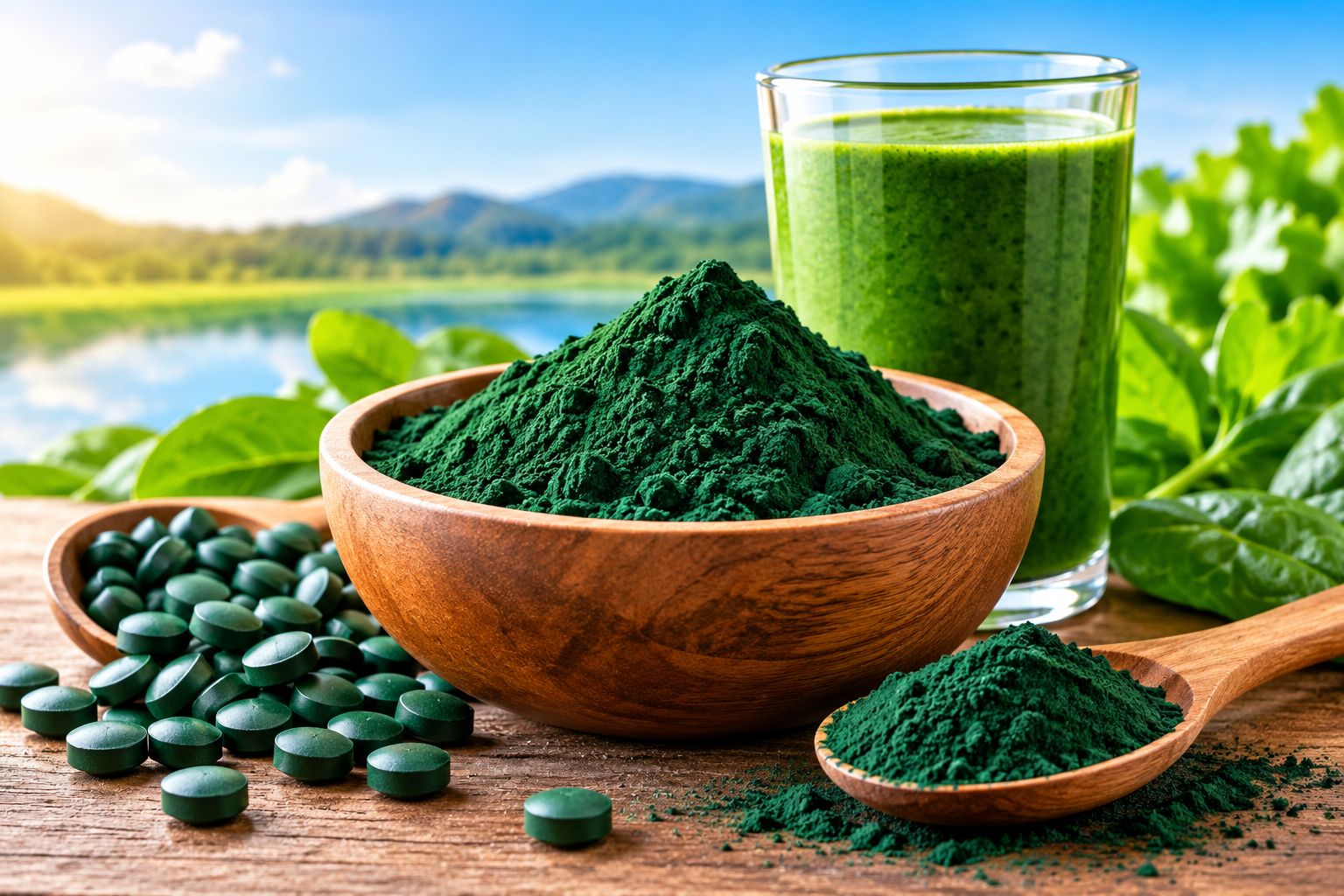
1. What Is Spirulina?
Spirulina is a blue-green, filamentous microorganism scientifically associated with Arthrospira, particularly Arthrospira platensis. It grows under suitable aquatic conditions and has a long history of use as food. Today, spirulina is commonly sold as a dietary supplement in powder, tablet, and drink forms.
Its popularity comes from its nutritional composition and the presence of bioactive compounds that researchers are investigating for their possible effects on human health.
According to the scientific review by Karkos and colleagues, spirulina has attracted attention as a source of protein and selected micronutrients. The review also examines its potential effects on inflammation, immune responses, allergic symptoms, and blood lipid levels.
2. Nutritional Composition of Spirulina
Spirulina contains several nutrients and naturally occurring compounds that contribute to its nutritional value.
- Protein: Spirulina can contain a high proportion of protein by dry weight. The reviewed article reports values of up to approximately 70%, although the actual amount depends on the product and its composition.
- Provitamin A (beta-carotene): This compound can be converted into vitamin A by the body and contributes to normal vision and immune function.
- Iron: Spirulina contains iron, an essential mineral involved in oxygen transport and normal physiological functions.
- B vitamins: The review discusses B vitamins, including vitamin B12. However, the presence of B12-like compounds does not necessarily mean spirulina provides a reliable source of biologically active vitamin B12.
- Bioactive compounds: Spirulina contains compounds such as phycocyanin, phenolic compounds, and gamma-linolenic acid, which have been investigated for their biological activities.
Important nutritional note: Spirulina should complement a varied and balanced diet rather than replace other nutritious foods or prescribed nutritional supplements.
3. What Does Scientific Research Say About Spirulina?
Researchers have investigated spirulina for several potential health applications. The strength of the evidence varies considerably between conditions.
A. Allergic Rhinitis and Inflammatory Responses
Allergic rhinitis is an allergic condition that can cause sneezing, nasal congestion, itching, and a runny nose.
The review describes human studies in which spirulina supplementation was associated with improvements in some allergic rhinitis symptoms compared with placebo. One study also reported a reduction in interleukin-4 (IL-4), a cytokine involved in certain allergic immune responses.
These findings suggest that spirulina may influence inflammatory and immune processes. Nevertheless, further research is needed to establish the most effective preparations, appropriate doses, long-term safety, and the consistency of these effects.
Spirulina should not replace prescribed allergy treatment.
B. Cholesterol and Cardiovascular Health
Some studies reviewed by Karkos and colleagues reported changes in blood lipid levels among people taking spirulina supplements. Findings included reductions in low-density lipoprotein (LDL) cholesterol and, in some studies, changes in triglycerides and high-density lipoprotein (HDL) cholesterol.
These results are scientifically interesting because elevated LDL cholesterol is an established risk factor for cardiovascular disease.
However, the studies available at the time of the review were relatively small. Larger, well-designed clinical trials are needed before spirulina can be recommended as a reliable treatment for high cholesterol.
For cardiovascular health, consumers should prioritize a balanced diet, regular physical activity, appropriate medical assessment, and prescribed treatment when necessary.
C. Immune Function
Spirulina contains bioactive compounds that have been investigated for their possible effects on immune responses.
The review describes studies reporting changes in immune-related markers, including immunoglobulin A (IgA), interferon-gamma (IFN-γ), and natural killer cell activity.
These findings suggest possible interactions between spirulina and the immune system. However, changes in laboratory markers do not automatically demonstrate improved protection against infections or better clinical outcomes.
More research is needed to determine the practical health implications of these findings.
D. Antiviral Potential
Laboratory studies have investigated spirulina extracts and compounds such as calcium spirulan for their effects on selected viruses.
Some experiments reported inhibition of viral replication under laboratory conditions. However, the review found no strong human clinical evidence establishing spirulina as an effective antiviral treatment.
Laboratory findings should not be interpreted as proof that consuming spirulina prevents or treats viral infections, including HIV.
E. Antioxidant and Anticancer Research
Phycocyanin, a blue pigment-protein found in spirulina, has demonstrated antioxidant and other biological activities in experimental studies.
The review also discusses preliminary research on oral leukoplakia, a condition involving white patches in the mouth that can sometimes be associated with an increased risk of oral cancer. One study reported regression of leukoplakia in some participants taking spirulina.
However, that study was not randomized or blinded, limiting the strength of its conclusions. The review also noted the lack of human clinical evidence establishing spirulina's antioxidant effects or its effectiveness in preventing or treating cancer.
Spirulina is not a proven cancer treatment and should never replace cancer screening, diagnosis, or medical care.
F. Chronic Fatigue and Other Proposed Uses
Spirulina is sometimes marketed for energy and vitality. Nevertheless, the review describes a small placebo-controlled study that did not demonstrate a significant improvement in chronic fatigue.
The authors concluded that the evidence was insufficient to establish spirulina as an effective treatment for chronic fatigue.
This illustrates why nutritional value and promising laboratory findings must be distinguished from demonstrated clinical benefits.
4. Safety and Responsible Use
The reviewed article described spirulina as generally well tolerated in the available studies, with no significant side effects reported in several investigations. However, this does not guarantee that every spirulina product is safe for every person.
Consumers should consider the following precautions:
- Choose quality-tested products: Spirulina products can vary in composition and quality. Contamination with microcystins, harmful microorganisms, or heavy metals is a potential concern when production and testing are inadequate.
- Check the product label: Review the ingredients, serving instructions, manufacturer details, expiry date, and applicable quality or regulatory information.
- Seek professional advice when appropriate: People who are pregnant or breastfeeding, have a medical condition, or take regular medication should consult a qualified healthcare professional before starting a supplement.
- Avoid replacing medical treatment: Spirulina should not be used as a substitute for prescribed medicines or professional treatment.
- Use only the recommended serving: There is no single dose established for treating all health conditions. Follow the instructions for the specific product and seek professional guidance where necessary.
5. How Can Spirulina Fit into a Healthy Lifestyle?
For people interested in improving dietary variety, spirulina powder may be incorporated into foods and beverages such as smoothies, depending on the product's instructions and individual preferences.
It can be considered as one component of a varied diet that includes vegetables, fruits, whole grains, legumes, appropriate protein sources, and healthy fats.
Consumers should evaluate supplements according to their nutritional composition, product quality, affordability, and suitability for their individual needs—not solely on advertising claims.
6. Conclusion: What Should Consumers Remember?
Spirulina is a nutrient-rich dietary supplement with an interesting scientific profile. Research reviewed by Karkos and colleagues suggests potential benefits for allergic rhinitis and possible effects on blood lipid levels and immune-related markers.
Nevertheless, the evidence is not equally strong across all proposed uses. Claims involving antiviral activity, cancer prevention, antioxidant effects, and chronic fatigue require further investigation.
The most responsible approach is to view spirulina as a potential nutritional supplement, not a medicine or a replacement for a balanced diet and appropriate healthcare.
IRONFIBER LTD promotes informed nutrition choices and encourages consumers to select quality-assured products and seek professional advice when needed.
Scientific Reference
Karkos, P. D., Leong, S. C., Karkos, C. D., Sivaji, N., & Assimakopoulos, D. A. (2011). Spirulina in clinical practice: Evidence-based human applications. Evidence-Based Complementary and Alternative Medicine, 2011, Article 531053. [https://doi.org/10.1093/ecam/nen058](https://doi.org/10.1093/ecam/nen058)
Editorial note: This article summarizes a scientific review published in 2011. It reflects the evidence discussed in that review and should not be interpreted as a comprehensive assessment of all research available today.