It’s 12:30. You’re not hungry. But it’s “lunchtime,” so you eat anyway. Three hours later, a mid-afternoon snack appears because a fitness influencer said to “keep your metabolism burning.” Sound familiar?
For decades we’ve been told that breakfast, lunch, and dinner—plus snacks—are the rules of healthy eating. But when researchers actually put meal schedules to the test, a different picture emerges: how often you eat matters far less than we were led to believe, and your body already has a remarkably smart system for telling you when it needs fuel.
Where Did “Three Meals a Day” Come From?
The three-meal pattern is largely a cultural and social habit—shaped by work shifts, school timetables, and family routines—rather than a biological requirement. Eating patterns vary widely across countries and eras, and a scientific statement from the American Heart Association noted that research on meal frequency does not point to one universally “correct” number of meals per day.
In other words, the clock on your wall was never a nutrition expert.
What Research Says About Meal Frequency
The “eat often to boost metabolism” myth
A classic review found that the energy your body spends digesting food depends on the total amount you eat, not on how many pieces you split it into. Eating six small meals or two larger ones with the same total calories produces essentially the same metabolic cost.
Controlled trials back this up. When people followed the same calorie-restricted diet as either three or six meals a day for eight weeks, eating more often did not lead to greater weight loss. A meta-analysis of multiple studies likewise concluded that any apparent benefit of frequent meals largely disappeared once researchers accounted for study quality and differences between trials.
Eating more often may even make you hungrier
In one tightly controlled experiment, increasing meal frequency from three to six per day—with identical total calories—did not improve fat burning and was actually linked to greater hunger and desire to eat.
Fewer, larger meals can work well
In a randomized crossover study of adults with type 2 diabetes, two larger meals (breakfast and lunch) produced greater reductions in body weight and liver fat, and better insulin sensitivity, than six smaller meals with the same energy content. A large observational study of about 50,000 adults also found that people who ate fewer meals per day tended to have a lower body mass index over time though observational data cannot prove cause and effect.
The bottom line on meal frequency
For most healthy adults, there is no strong evidence that eating three or more times a day is necessary for health or a “fast metabolism.” Food quality, total intake, and consistency matter more than the number on your meal schedule.
Your Body Has Its Own Hunger Clock
Hunger isn’t random. The hormone ghrelin, produced mainly by the stomach, rises before meals and falls after eating—a pattern suggesting it helps signal when to start a meal.
Here’s the twist: ghrelin can learn your schedule. Research suggests that ghrelin peaks tend to line up with people’s habitual meal times. So if you’ve always eaten at noon, your body may start “asking” for food at noon—not necessarily because it needs fuel, but because it’s been trained to expect it.
Memory and habit also play a surprisingly big role. In a well-known study, people with severe amnesia who could not remember having just eaten readily ate a second, and sometimes a third, full lunch minutes later. Eating is driven not only by physical need, but also by cues, routine, and the clock.
Yes, “Hangry” Is Real
That irritable, short-fused feeling when you’re hungry isn’t in your head—well, it is, but it’s real. Laboratory research shows that hunger can shift people toward more negative emotions, especially when they aren’t paying attention to their bodily state. A field study that tracked adults in daily life found that greater hunger was associated with higher anger and irritability and lower pleasure.
The encouraging finding? In MacCormack and Lindquist’s (2019) work, people who were more aware of their emotions were less likely to become hangry. Noticing your hunger early is a skill—and a powerful one.
A friendly note on our title
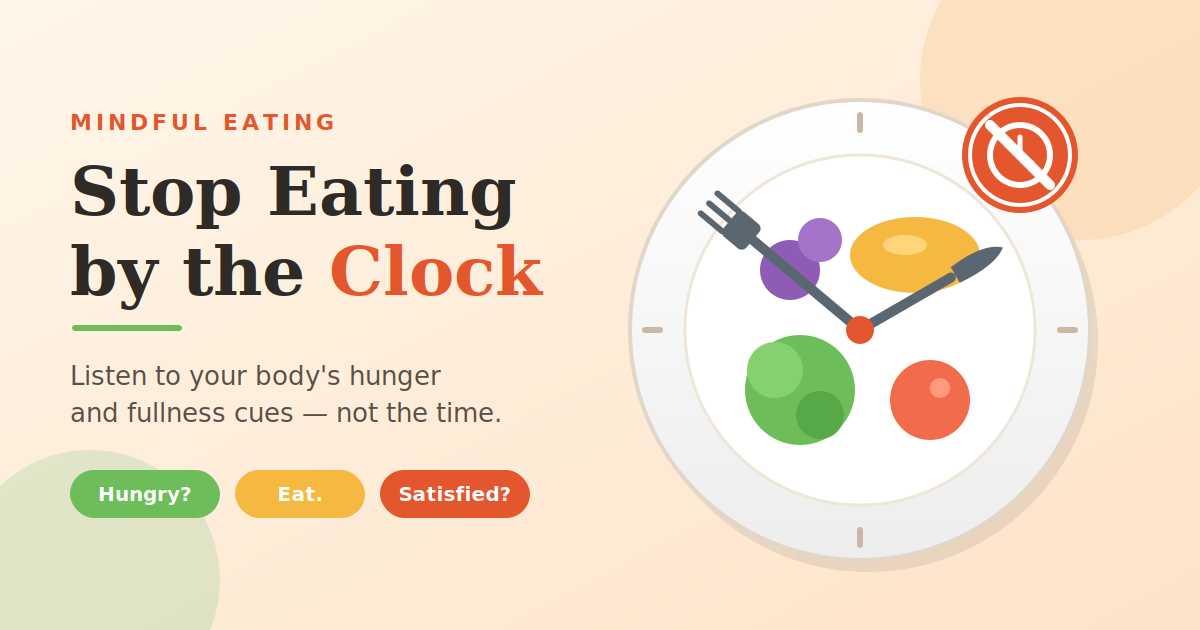
“Eat when you’re hangry” is our playful way of saying trust your real hunger, not the clock. Ideally, you’ll eat when you notice genuine hunger—before it escalates into full-blown hanger. Waiting until you’re ravenous often leads to rushed eating and overeating.
The Science of Listening to Your Body
This approach has a name: intuitive eating—eating in response to internal hunger and fullness cues rather than external rules. Researchers have developed validated tools to measure it, and a growing body of evidence links it to better health outcomes.
A literature review found that intuitive eating was associated with lower body mass index, better psychological health, and healthier eating behaviors. A later meta-analysis of more than 90 studies found that intuitive eating was linked to greater body appreciation, self-esteem, and well-being, and to fewer disordered eating symptoms.
Separately, research on intermittent fasting and longer gaps between meals suggests that giving the body periods without food can support metabolic health for some people. The shared theme across this research: constant grazing is not a biological necessity.
Practical Tips to Get Started
● Check in before you eat. Take a moment to rate your hunger. Eating at a 3–4 helps you avoid both clock-eating and hanger.
● Eat slowly and without screens. Fullness signals take time to register; distraction makes them easier to miss.
● Build satisfying meals. Protein, fiber, healthy fats, and vegetables help meals keep you full longer, making fewer meals more comfortable.
● Keep a nourishing option handy. If hunger shows up at an inconvenient time, a piece of fruit, yogurt, or a handful of nuts prevents a slide into hanger.
● Be flexible, not rigid. The goal isn’t a new rule (“never eat before noon”); it’s trusting your body. Some days you’ll eat twice, some days four times.
● Stay hydrated. Thirst and tiredness can sometimes feel like hunger—a glass of water is a simple first check.
Who Should Be Careful With This Approach
Listening to hunger cues is a healthy default for many adults, but it isn’t right for everyone. Please talk with a doctor or registered dietitian before changing your eating pattern if you:
● Have diabetes, especially if you take insulin or medications that can cause low blood sugar
● Are pregnant, breastfeeding, or trying to conceive
● Have a current or past eating disorder—hunger cues may not be reliable, and structured eating is often an important part of recovery
● Are a child or teenager, an older adult with a low appetite, or managing a chronic illness
● Take medications that must be taken with food, or that affect appetite
● Are an athlete with high training demands who needs carefully timed fueling
Key takeaways
● Three meals a day is a cultural habit, not a biological law.
● Eating more often does not “boost metabolism” or guarantee weight loss.
● Your hunger hormones can adapt to your schedule—so clock hunger is partly learned.
● Hangry is real; noticing hunger early helps you eat calmly and mindfully.
● Eat when your body genuinely asks—and choose foods that truly nourish you.